
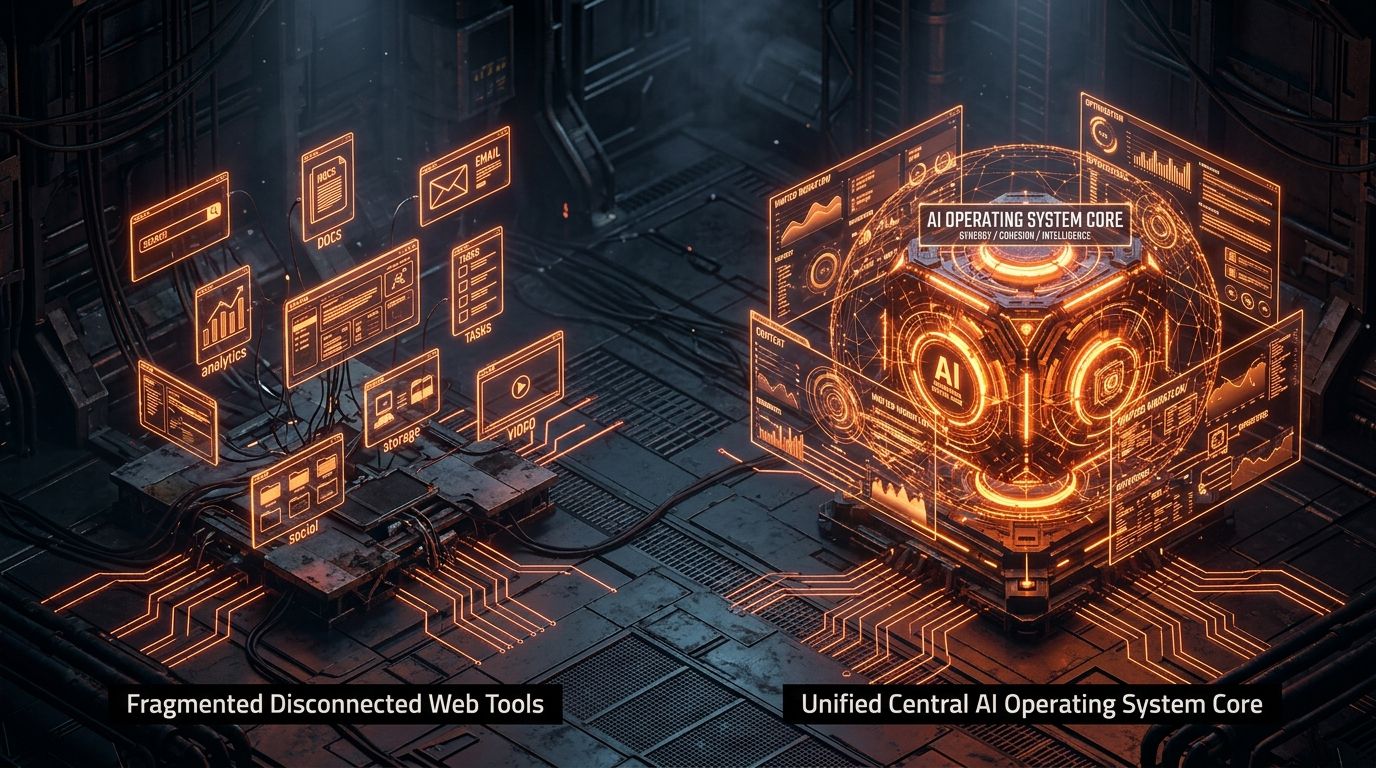
The modern Web3 tech stack is cluttered with point solutions. Founders often find themselves juggling a dozen separate tools: one for social scheduling, another for wallet analytics, a third for email newsletters, and multiple agency dashboards. This fragmentation creates significant operational friction and drains valuable runway.
The future of Web3 growth isn’t adding another SaaS tool to your bookmark bar—it is consolidating your stack under a unified AI Operating System.
The Fragmented Web Tax in Web3 Growth
Operating across disconnected platforms imposes a hidden cost on Web3 teams, known as the Operational Chaos Tax. When tools do not talk to each other, team members are forced to act as manual data bridges:
- Siloed Intelligence: Wallet data in your analytics tool cannot automatically inform your X content strategy or ad targeting.
- Workflow Friction: Every marketing campaign requires manually exporting CSVs, re-importing email lists, and copy-pasting content across tabs.
- Sluggish Reaction Speed: Market shifts in Web3 happen in minutes, but fragmented tools delay campaign deployment by days.
AI Operating Systems: The Paradigm Shift
An AI Operating System (AI OS) replaces disconnected tools with an integrated intelligence and execution core. Rather than acting as static software, an AI OS connects directly to your data sources and communication channels, operating as an autonomous team member.
| Dimension | Fragmented Web Stack | Unified AI Operating System |
|---|---|---|
| Architecture | 10+ disconnected SaaS tools & spreadsheets. | Single unified AI growth engine (ThinkOS). |
| Data Flow | Manual exports and broken API integrations. | Real-time native data aggregation. |
| Execution Model | Human-dependent copying, pasting, and scheduling. | Autonomous multi-channel publishing & routing. |
| Cost Structure | Multiple recurring SaaS subscriptions + agency fees. | Single predictable operating system subscription. |
Why Web3 Projects Are Upgrading to ThinkOS
ThinkOS was built specifically to solve the Web3 fragmentation crisis. By unifying strategic planning, creative generation, campaign distribution, and on-chain analytics into one operating environment, Web3 teams eliminate software bloat and accelerate their shipping speed.
For a detailed breakdown of how an AI Marketing OS functions under the hood, explore What Is an AI Marketing OS?. To see how static CRMs are being replaced by dynamic AI layers, check out Why AI is Replacing Static CRMs in Web3 Growth.
Unifying Your Marketing Execution Layer Today
Upgrading to an AI Operating System allows Web3 founders to refocus on what matters most: product development, tokenomics, and high-level ecosystem partnerships. By delegating day-to-day execution to an autonomous system, you build a scalable growth engine that grows with your protocol.
Authored by ThinkOS
#AIOperatingSystem #Web3Growth #ThinkOS #TechStack